My approach to flower preservation
I used to stuff my grandmother's folktale books with weeds and wildflowers during childhood summers at her house. Invariably, I'd forget about them until the following year. As I opened the same books on lazy afternoons, crunchy brown leaves would tumble out. A happy surprise followed by a pang of regret that they'd lost everything that made them beautiful.
Decades later, I open my flower presses and see something completely different. The colors are still vibrant, sometimes taking on new hues I didn't expect. The greenery is smooth. The petals are so thin and delicate they could melt under my fingers.
That gap between my grandmother's crumbly book-pressed leaves and what comes out of my studio is everything I've spent four years learning. It's the difference between simply pressing flowers and preserving them. And it's the reason I do this work the way I do: one artist, one bouquet at a time, with every decision made by hand.
When your bouquet arrives
The clock starts the moment your flowers leave water. Every hour matters. Fresh flowers within one to three days of your wedding preserve with the best color and the most lifelike quality. By day five or six, the window is narrowing. By two weeks, we're in restoration territory.
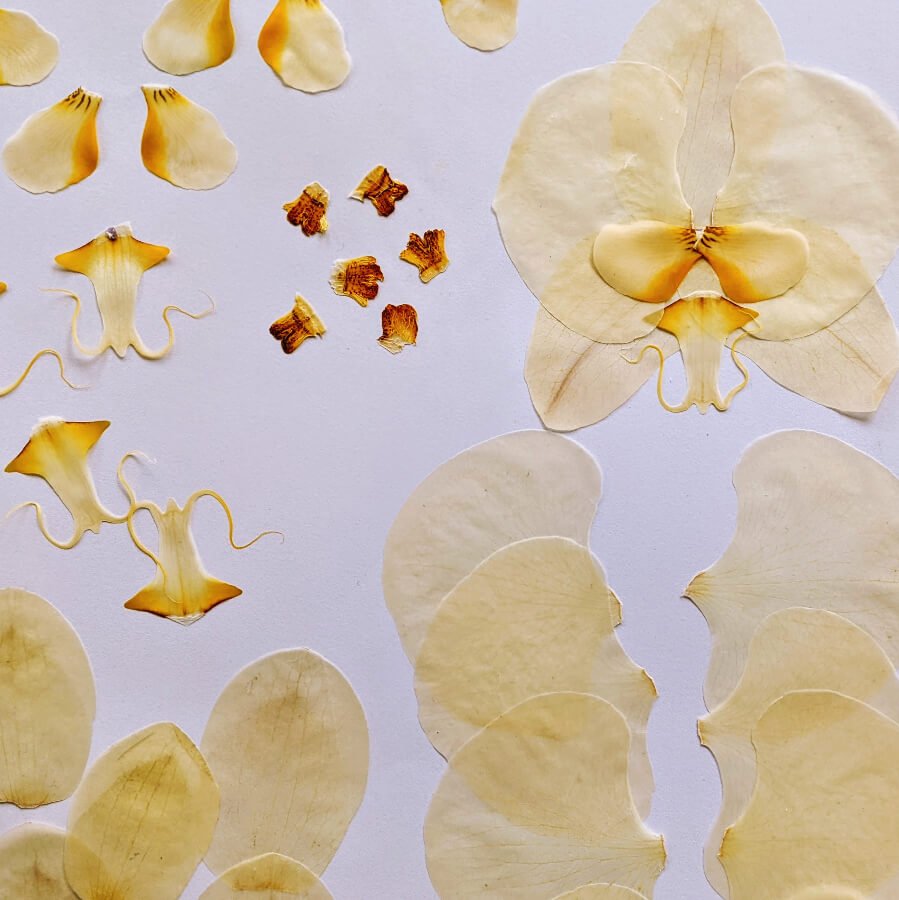
This is why I take the intake process seriously. When your bouquet arrives, I assess every bloom individually. Which flowers should be pressed whole? Which ones need to come apart? A rose that looks simple from the outside might have 40 or 50 petals layered tightly together, and if I press it whole, moisture trapped at the base will brown the inner petals within days. So I deconstruct it. Every petal comes off. Each one gets pressed separately. Later, I'll rebuild that rose petal by petal until it looks like itself again.
Most people don't realize the flower in their frame was taken apart and reconstructed. That level of control is what separates crisp, vibrant results from the brown, crumbly ones you get from a heavy book and good intentions.
What the pressing process actually looks like
I use a combination of pressing methods depending on the flower. Traditional presses with wood planks and layers of cardboard and blotting paper. A foam press I fabricated myself for superior color retention. Silica gel drying when I want 3D texture in a shallow frame. Choosing the right method for each bloom is one of those quiet decisions that shapes the entire finished piece.
Pressing is not a set-it-and-forget-it process. I joke that each press is a baby that needs regular diaper changes. Flowers release a surprising amount of water, and that moisture saturates the blotting paper fast. If I don't swap it out on schedule, the flowers sit in dampness and develop mold or brown spots. Orchids and sunflowers are especially finicky. They need daily paper changes and constant airflow. My presses sit under fans that run around the clock, and a dehumidifier keeps the studio's humidity in check.
The drying phase alone takes up to four weeks. Rushing it is the fastest way to ruin flowers that can't be replaced. Slow, even moisture removal is what preserves color and prevents the brittleness that makes petals crumble the moment you try to work with them.
Where the art lives
Once the flowers are pressed, the part most people think of as "preservation" is actually finished. What comes next is closer to painting or collage. This is where I spend the most time and where my artistic perspective shapes the piece you'll live with for decades.
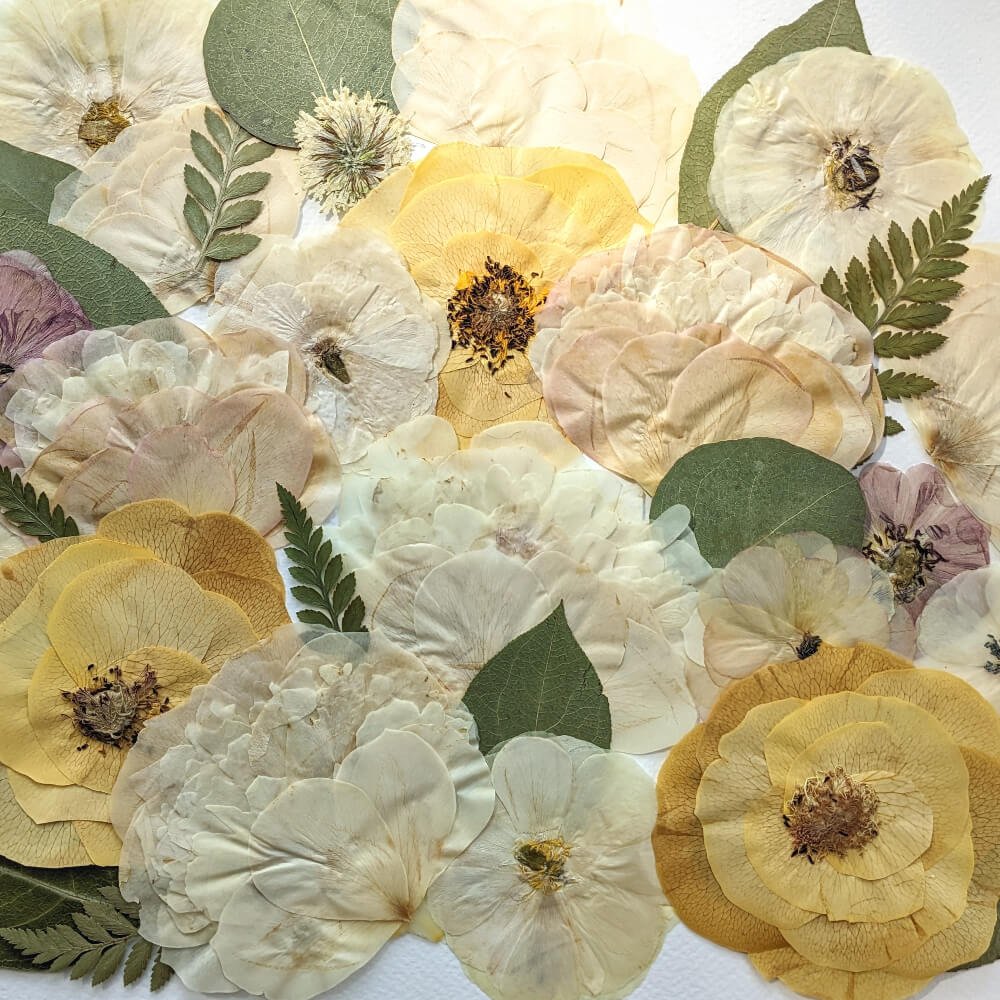
I start by reassembling deconstructed flowers. That rose I took apart? Now I'm layering its petals back together, choosing which ones face forward, deciding how open or closed the bloom should feel. I'm making dozens of small compositional choices that determine whether the final piece feels like a stiff arrangement or something with movement and life.
Then comes color correction. This is one of the things I feel most strongly about in my practice. I correct every element in an arrangement, not selectively. Here's why: uncorrected flowers will continue to fade over time, while corrected ones hold. If I only correct some blooms, you end up with an inconsistent patchwork a few years down the road: some elements looking fresh, others faded. I learned this the hard way early on when a client's roses shifted to an unexpected color and she was understandably disappointed. Now, color correction is included as standard on every commission. You shouldn't have to pay extra for your piece to hold up over time.
After color correction, I create design mock-ups for your approval. Then I glue each element into the approved arrangement by hand. The design phase alone takes 5 to 7 hours. When you add in prep, pressing, finishing, and framing, a single piece requires 14 to 18 hours of skilled labor spread across several weeks.
The materials that protect your investment
I've seen pressed flower pieces from the 1990s that still look lovely. I've also seen pieces from five years ago that look decades old. The difference almost always comes down to materials.
Every frame I create uses museum glass that blocks 99% of UV light, acid-free matting that won't yellow or degrade, and solid wood frames built to order by my trusted framers. These aren't upgrades or premium add-ons. They're standard on every commission because I want the piece you hang on your wall today to still look beautiful in twenty years. Cheaper alternatives, standard glass, regular mat board, can look identical on day one. Five years later, the difference becomes impossible to ignore.
Why one artist matters
My practice is just me. I press your flowers, I design the layout, I do the color correction, I assemble the frame, I package it for pick-up or shipping. No one else touches your bouquet.
I've chosen this deliberately, even though it means longer turnaround times and a limited number of commissions each year. When one person handles every step, there's a thread of continuity and care that runs through the entire process. I know exactly how each flower in your arrangement responded to pressing because I watched it happen over weeks. That knowledge informs every design choice I make later.
Could I hire help and take on more clients? Yes. I've chosen not to because the work feels different when it passes through multiple hands. For the couples and families who choose Bloom & Make, the one-artist promise is the point.
The little secrets flowers reveal
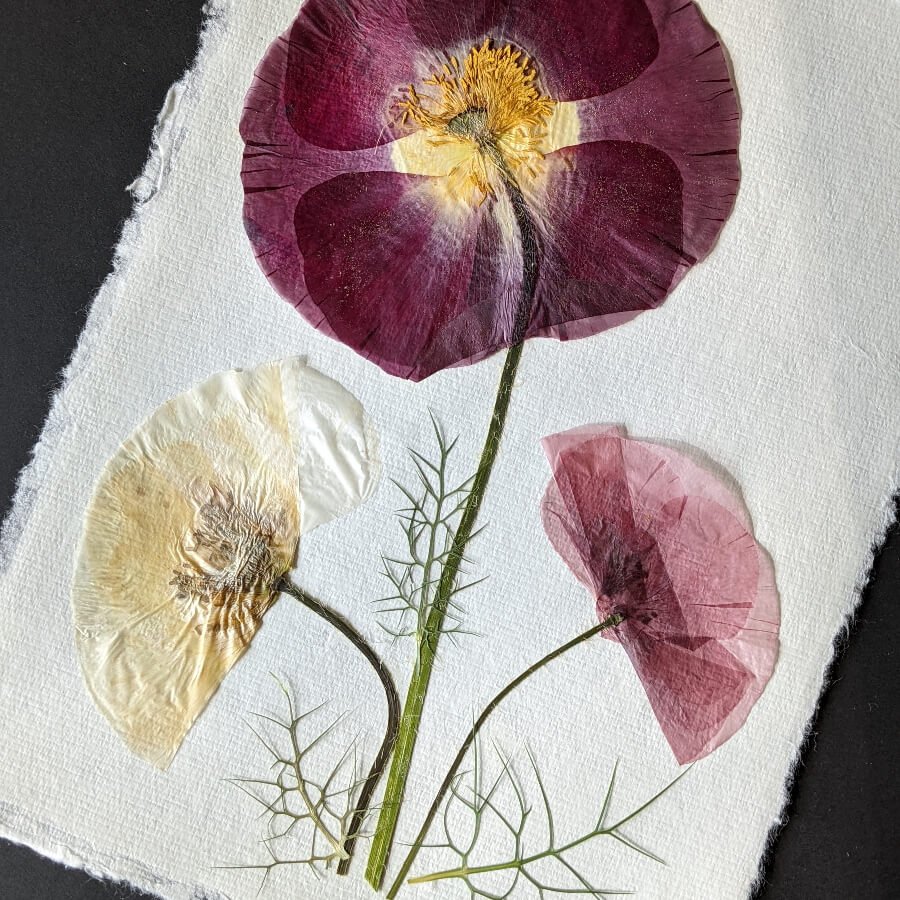
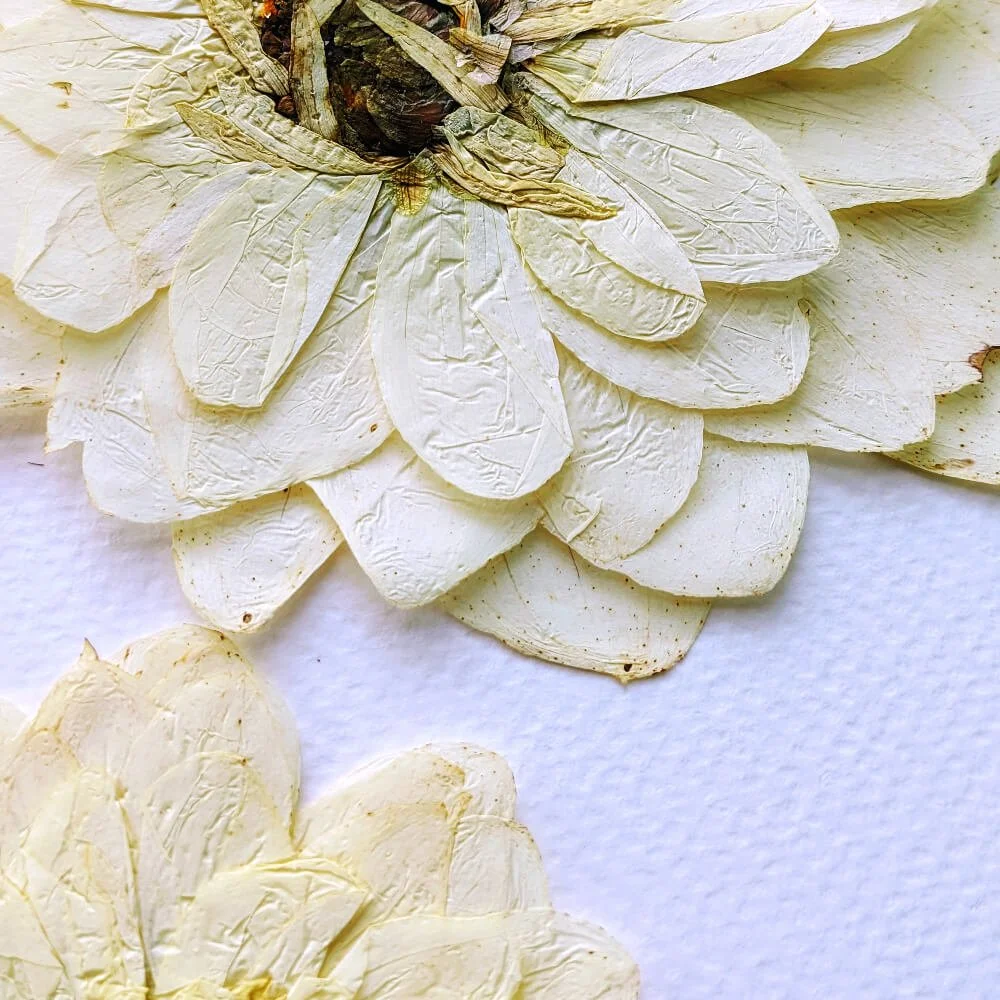
The most surprising part of this work is how much more I've learned about flowers by taking them apart. Little secrets come to life in the pressing process. Poppies have the most elegant symmetry I've seen in any bloom. Pressed cinnamon basil retains its incredible fragrance. Each zinnia petal is attached to a future seed. After pressing tens of thousands of flowers over four years, I still discover things that stop me mid-task.
I grow many of the flowers I work with in my own cutting garden. The connection between growing a flower from seed, nurturing it through the season, harvesting it at peak bloom, and then preserving it in a piece of art is hard to explain to someone who hasn't experienced it. It gives me an intuition about each variety that I couldn't have developed any other way.
When I preserve your wedding bouquet or memorial arrangement, that same attentiveness carries over. I want the details that made your flowers special, the curl of a petal, the way a stem arched, to come through in the finished piece. Not a generic pressed flower arrangement. Yours.
Your flowers, whenever you're ready
Whether your bouquet is still fresh from last weekend or air-dried in a closet from years ago, I'd love to hear about it. I've developed techniques to restore already-dried flowers that most people assume are too far gone. And for bouquets that truly can't be saved, recreation with matching flowers is always an option.
If you're curious about what preservation costs and why, or you want to understand why the timeline is what it is, I've written honestly about both. And if you're ready to start a conversation about your flowers, reach out here.